
((Dear customer, to view and compare THD explanations at a glance, be sure to refer to the table at the end of this article))
What is harmonic distortion or THD?
Harmonic distortion or THD (Total Harmonic Distortion) is a unit for measuring the level of distortion in a waveform due to the presence of harmonics. THD is the ratio of the total harmonic component to the fundamental waveform, which is expressed as a number from 1 to 200 and indicates how closely a waveform matches a sine wave. The lower the THD value, the better the sinusoidal quality and has a negative impact and less energy on the power grid. According to the standard, it is better for this value to be less than 10.
is the ratio of the total harmonic component to the fundamental waveform, which is expressed as a number from 1 to 200 and indicates how closely a waveform matches a sine wave. The lower the THD value, the better the sinusoidal quality and has a negative impact and less energy on the power grid. According to the standard, it is better for this value to be less than 10.
What are harmonics?
Today, many electrical devices, including LED drivers, are built with electronic circuits that do not draw continuous current from the mains, but rather short pulses. This results in a wave that is no longer sinusoidal and has an irregular shape.
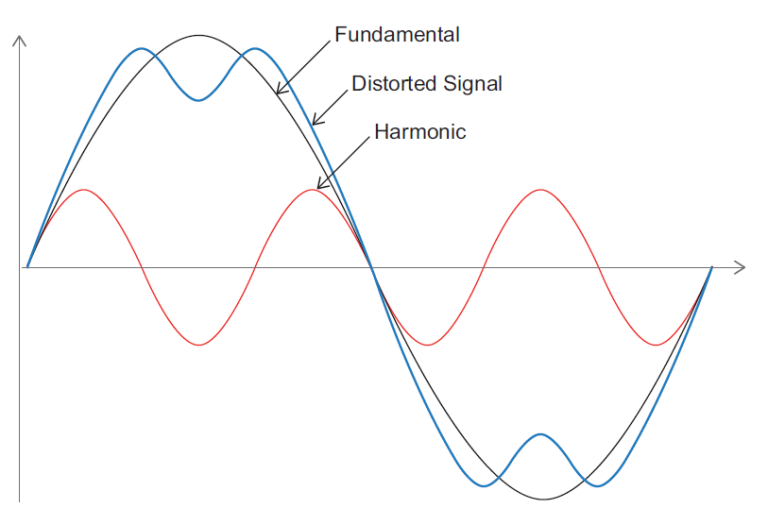
Harmonics are higher multiples of the frequency of the fundamental wave (voltage or electric current) that can result in a distorted waveform with irregular peaks and valleys, and are produced by nonlinear loads in the power network. For example, if the fundamental frequency is 50 Hz, the second order frequency is 100 Hz, the third order is 150 Hz, and the fourth order is 200 Hz.
Harmonic Effects:
Harmonics generated by non-linear loads can cause losses in transformers, motors, and transmission lines, as well as disrupt the operation of control and protection systems.
The concept of harmonic distortion or THD.
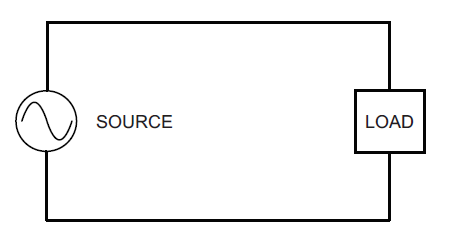
Total harmonic distortion or THD is best understood when a power system is defined in its simplest terms (the power source and the load) as shown in the figure below:
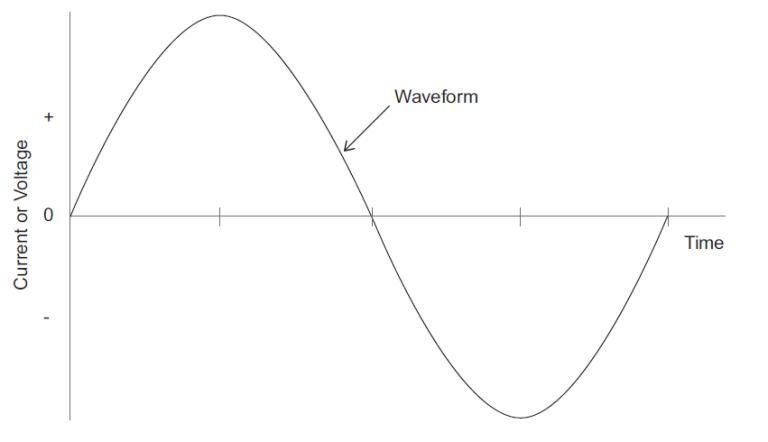
Since the load affects the current draw on a system, the power quality of the system is often affected by the type of load. Loads can be linear or nonlinear. A linear load draws a current that is sinusoidal in nature and has a smooth current and voltage transition, so it generally does not distort the waveform as seen in the figure below:
Many household appliances such as electric water heaters, irons, and incandescent lamps have resistive loads that are relatively linear.
Non-linear devices utilizing diodes and SCRs (or thyristors) impose a non-linear load on the power source, causing significant distortion in the source waveform, as shown in the figure below:
Calculating THD:
Harmonic frequencies are considered to be integer multiples of the fundamental frequency. For example, if the fundamental frequency is 50 Hz, the second order frequency is 100 Hz, the third order is 150 Hz, and the fourth order is 200 Hz. Total Harmonic Distortion (THD), which is the degree to which a waveform deviates from a pure sine wave, is calculated by dividing the square root of the sum of the squares of the harmonic components by the RMS voltage of the fundamental frequency. This value is expressed as a percentage of the fundamental voltage. When the harmonics of a sine wave are zero, there is no error in it.
THD in LED lights:
LED lights, which are one of the most widely used lighting products today due to their low power consumption and abundant light, have strict regulations regarding THD. LED lights are powered by drivers that are non-linear loads and have a diode bridge to rectify the AC input signal and convert it to DC for the LEDs. The switching operation of these diode bridges produces a harmonic current that ultimately distorts the sine wave and causes THD.
Public Relations of Milad Noor Lighting Industries, Mashhad